
ECO·IN Building Demand Intelligence Platform
Hardware – The Measure Layer
Continuous Data Engine
This is the Measure layer of the ECO·IN Building Demand Intelligence Platform – the autonomous data engine behind everything the platform can do. ECO·IN collects its raw data directly: from breathing zones in occupied spaces, from equipment, rooftop outdoor conditions, and control signals across the building. It does not depend on a BMS, external feeds, or average-air measurements. That independent data stream allows the Software layer to build understanding, Sol AI to make demand-based decisions, and VEM to verify the result.
17+ parameters. Every 10 seconds. From every room.
ECO·IN hardware does not sample building conditions occasionally. It captures a continuous, synchronized stream of signals across every monitored space – including CO₂, PM2.5, TVOC, temperature, humidity, occupancy-related signals, AHU supply air, return air, differential pressure, fan speed, valve position, chilled water flow, equipment power draw, vibration signature, and more. All 17+ parameters are synchronized every 10 seconds.
This is not monitoring alone.
It is the raw material the Software layer uses to build the Four Building Signatures.
What the Hardware Layer Does
ECO·IN hardware captures the high-frequency signal stream that reflects real building demand, connects directly to AHU and FCU systems, and enables precise demand-based response at both room and system level. No BMS is required. Where a BMS exists, ECO·IN operates above it as an independent intelligence layer.
01
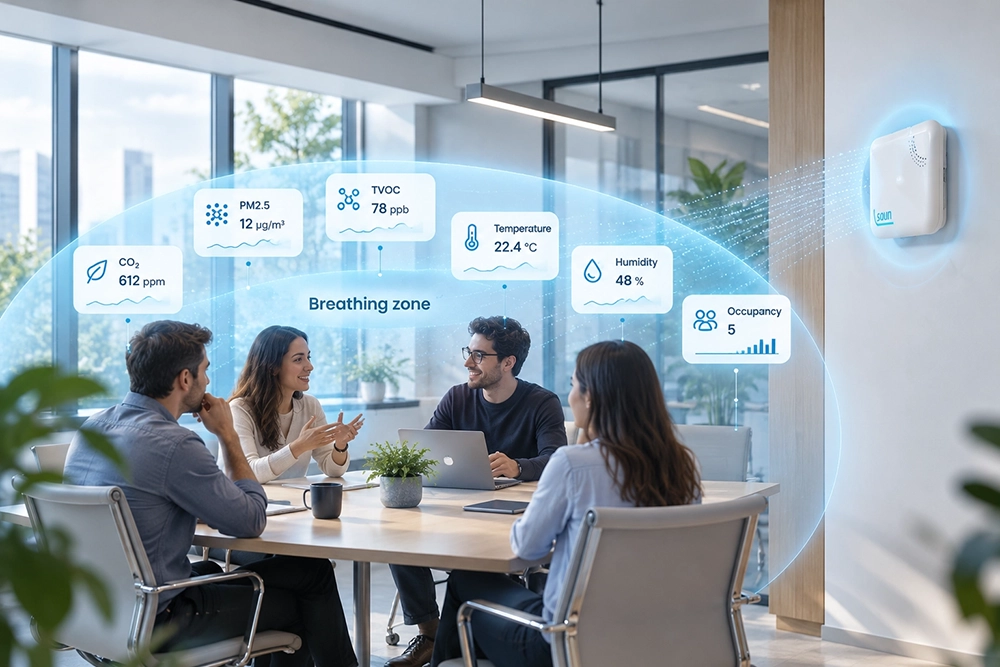
Measure real room conditions
Capture CO₂, PM2.5, TVOC, temperature, humidity, and occupancy-related signals in the breathing zone – not just in return air or exhaust paths.
02
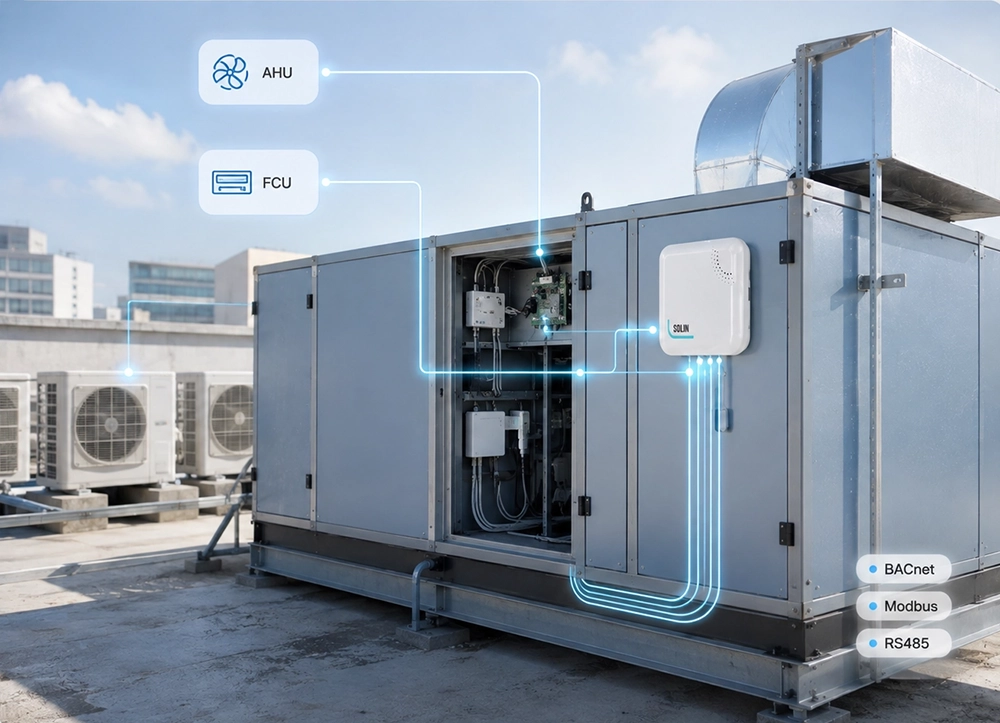
Connect directly to HVAC systems
Interface directly with AHUs and FCUs through retrofit-ready controllers and standard protocols such as BACnet, Modbus, and RS485. No BMS is required. Where a BMS exists, ECO·IN operates independently above it.
03
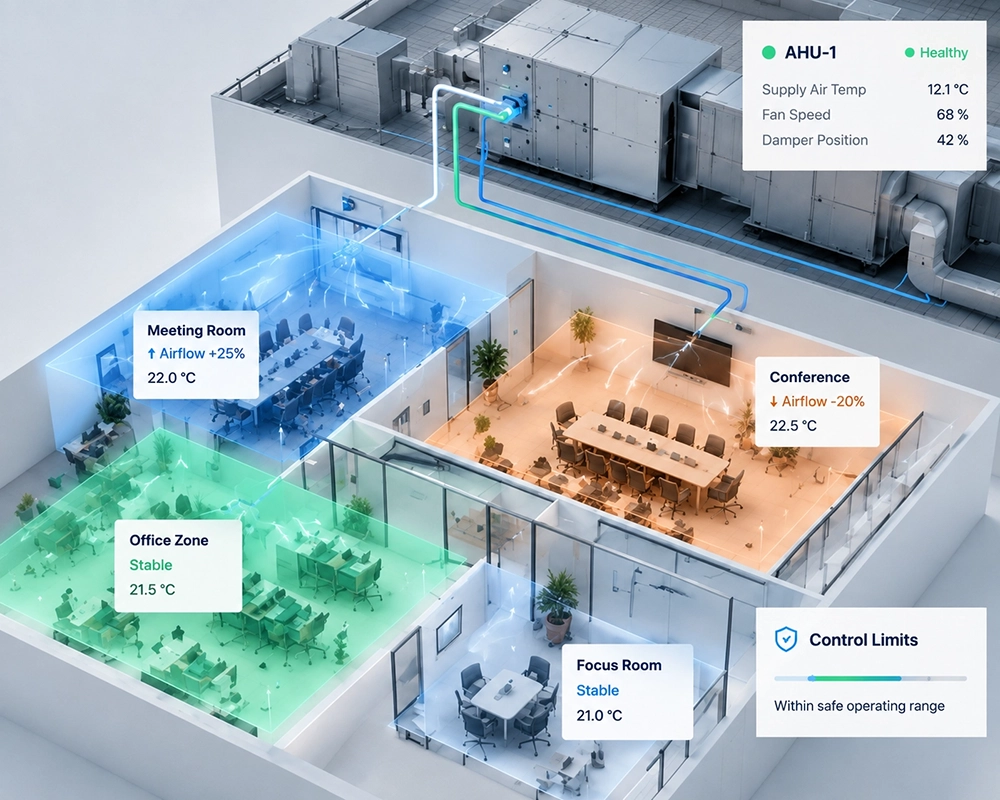
Enable precise, bounded control
Support zone-level airflow and temperature optimization, stable DCV sequences, and equipment health monitoring without interfering with safety systems.
These signals become the raw material for the Four Building Signatures – Occupancy & Usage, Thermal & Comfort, IAQ, and Energy – which the Software layer builds from weeks of continuous observation. That high-frequency signal stream makes building-specific intelligence, Sol AI-driven HVAC decisions, and defensible VEM evidence possible.
Core Hardware Components
These four components work together as one integrated sensing and control mesh. Sol Sense and MHSense listen. Sol AirDCV and Sol SmartCoil do both – they listen to the building and respond to it. Together, they give the platform complete coverage: from the air in the room to the equipment consuming the energy.
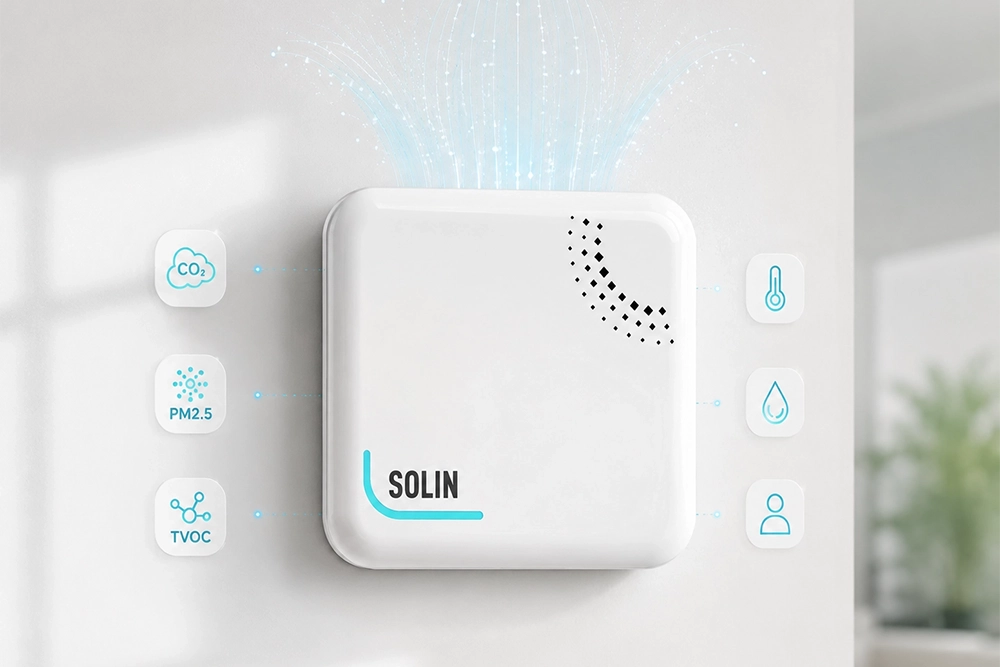
Sol Sense
The Environmental Sensor
↑ Feeds upward → builds IAQ and Occupancy Signatures
Measures CO₂, PM2.5, TVOC, temperature, and humidity directly in the room, at breathing-zone height. The CO₂ signal specifically provides the rise-rate and decay data the Software layer uses to build the Occupancy & Usage Signature. Sol Sense does not infer occupancy – it captures the raw signal. The metabolic interpretation happens in the Software layer above. Installed in minutes, with RS485 Modbus connectivity and designed to support LEED v5, RESET Air Grade B, and UL 2095 Grade B-related requirements.
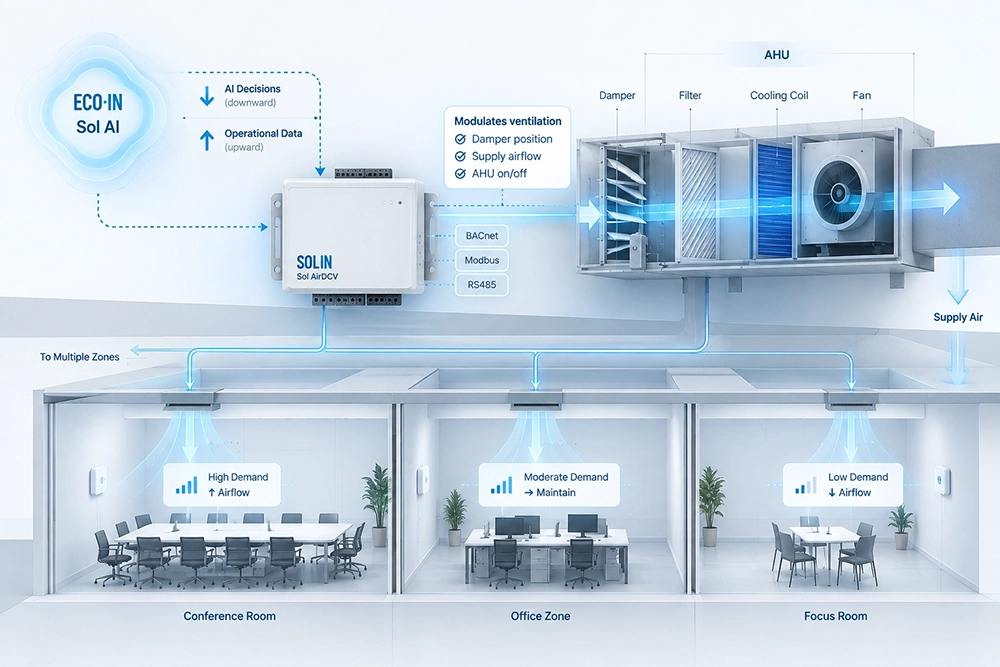
Sol AirDCV
Ventilation Intelligence Controller
↑ Feeds upward → ventilation response and AHU behavior
↓ Executes downward ← receives Sol AI decisions
Connects directly to AHU and FCU systems and executes demand-based ventilation based on occupancy, IAQ, thermal conditions, and real operating demand – not fixed schedules or simple thresholds. When Sol AI determines that demand conditions justify a change – based on CO₂ rise rate, occupancy signature, and cross-signature agreement – Sol AirDCV modulates the response: damper position adjusted, AHU supply airflow matched to actual zone demand, and AHU activation or deactivation managed within defined confidence limits. The action is bounded, reversible, and logged. Supports demand-controlled ventilation aligned with ASHRAE 62.1-2025.
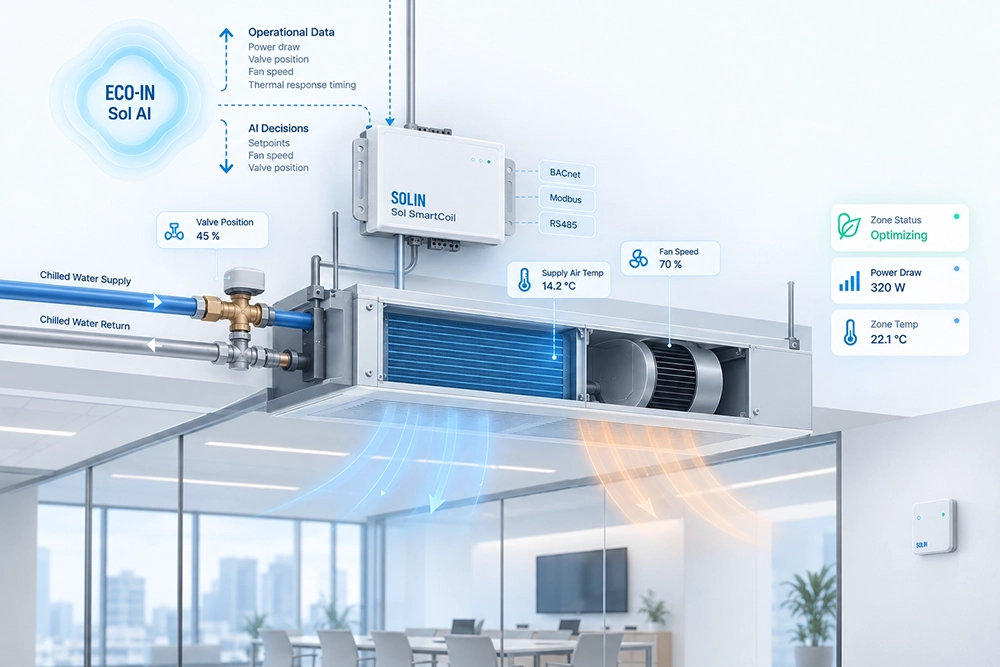
Sol SmartCoil
Zone-Level HVAC Optimizer
↑ Feeds upward → power draw, valve position, fan speed, thermal response timing
↓ Executes downward ← receives Sol AI decisions
Executes bounded HVAC decisions at zone level based on occupancy, thermal demand, IAQ conditions, and actual room behavior. SmartCoil captures zone-level power draw, valve position, fan speed, and thermal response timing as raw inputs to the Energy and Thermal Signatures. When Sol AI determines that action is appropriate, SmartCoil executes setpoint adjustment, fan-speed modulation, and valve repositioning based on thermal demand versus actual load – within comfort-safe bounds. Zone-level precision. No BMS required. Every action is logged to the Decision Log.
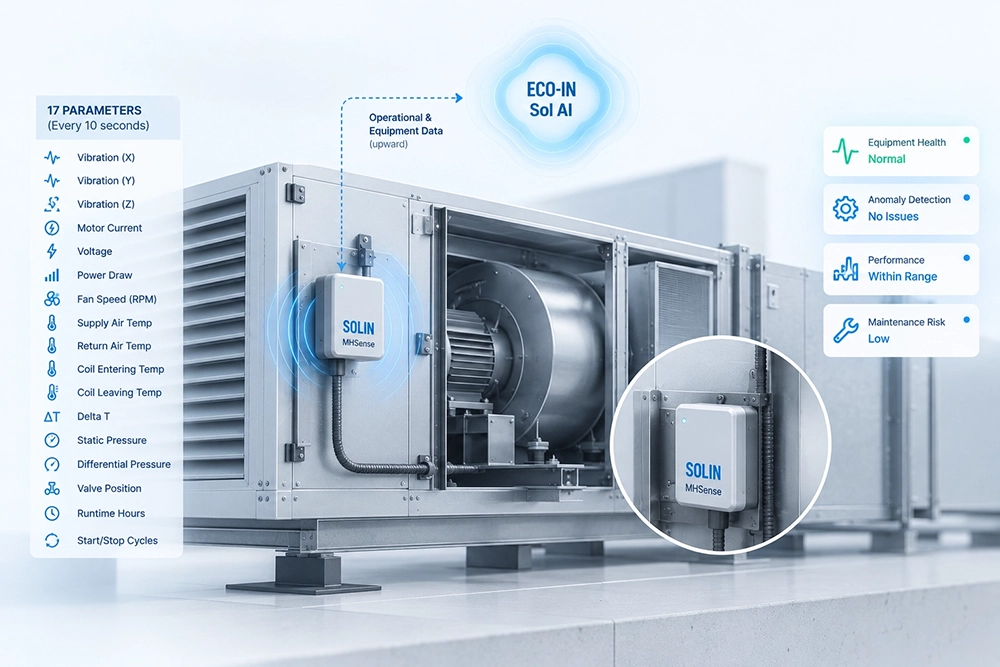
MHSense
Equipment Health Monitoring
↑ Feeds upward → contributes predictive maintenance signals to the Energy Signature
Monitors machine health through vibration, anomaly detection, and 17 measured parameters captured every 10 seconds, helping identify abnormal behavior before it becomes downtime, comfort failure, or energy waste. Beyond predictive maintenance, MHSense also supports real-time operational diagnosis, revealing issues such as faulty valves, clogged filters, abnormal PM conditions, and cooling-performance problems that affect comfort, IAQ, and efficiency. MHSense is a data-capture layer only – it does not execute AI decisions. Its role is to feed predictive and diagnostic signals upward into the platform, strengthening equipment-level visibility and energy profiling across the building.
Operational Impact
17+ parameters, every 10 seconds
A continuous signal stream that allows ECO·IN to build real Building Signatures – not assumptions.
Direct AHU and FCU connection
No BMS required. Sol AI decisions reach the equipment that actually uses energy, with the closed loop executed locally at controller level.
The loop closes at the equipment level
Sol AirDCV and Sol SmartCoil listen upward and execute downward – connecting building demand directly to HVAC response.
One platform. Four layers. Measurable performance.
Cut through blind spots, fixed schedules, and unverified claims with one connected system built to measure, understand, control, and verify.