
Sol-In Solutions for Real Building Performance
Save energy. Improve air quality. Verify performance.
Sol-In’s ECO·IN Building Intelligence Platform brings a new closed-loop approach to building performance: real-time sensing, demand intelligence, HVAC control, and VEM verification in one platform. It goes beyond dashboards and alerts by translating building data into action – helping reduce energy waste, improve IAQ and comfort, and produce operational evidence for climate and compliance goals.
The old trade-off no longer works
For years, buildings were managed as if every goal came at the expense of another. Save energy, and comfort or air quality may suffer. Increase ventilation, and operating costs rise. Report sustainability progress, but struggle to prove what actually changed.
ECO·IN was built for a different operating reality: energy savings, healthier indoor conditions, and climate evidence can be connected through one closed loop.
Save energy – risk comfort
Traditional HVAC reduction can cut runtime without knowing whether a zone still needs cooling, heating, or ventilation.
Improve air quality – increase cost
More fresh air can improve IAQ, but without demand intelligence it can also drive unnecessary HVAC energy use.
Report performance – lack proof
Dashboards may show trends, but they don’t prove what changed, where, and whether the result was sustained.
One closed loop behind every solution
Every ECO·IN solution is built on the same operating logic: measure real conditions, understand predicted demand, control HVAC where action is needed, and verify the result through VEM. AirDCV and SmartCoil execute local HVAC control, while ECO·IN also translates building-wide demand into operator-approvable plant-level recommendations. Forecasting across 5 minutes, 15 minutes, 60 minutes, end of day, and tomorrow helps buildings act before waste, discomfort, or IAQ risk becomes part of the operation.
MEASURE
Sol Sense
Captures occupancy-related, IAQ, and thermal data inside occupied spaces.
UNDERSTAND
ECO·IN + Sol AI
Learns how each building behaves and predicts demand before it peaks.
CONTROL
AirDCV + SmartCoil
Local HVAC responds, with plant-level recommendations where needed.
VERIFY
VEM
Turns the outcome into evidence: kWh, cost, CO₂, ROI, IAQ, comfort.
↺ ONE CLOSED LOOP · CONTINUOUS
Solutions connected by real demand
01
Energy Savings
Cut HVAC waste. Verify every saving.
ECO·IN reduces unnecessary HVAC operation by controlling local systems according to real demand and supporting smarter plant-level decisions. VEM verifies savings against a clear baseline, translating reduction into kWh, cost, CO₂, ROI, and payback.
- Demand-based HVAC control
- VEM-verified savings
- Up to 44% HVAC reduction

02
Climate & Compliance
Turn building performance into climate evidence.
ECO·IN helps reduce actual HVAC energy use and translate verified reductions into Scope 2 carbon impact, ESG outputs, MRV support, and reporting evidence. It gives buildings a measurable performance layer for LEED v5, CSRD, Local Law 97, ASHRAE, and other climate and building-performance workflows.
- Scope 2 reporting support
- ESG evidence
- Reporting-ready performance data

03
Health & Indoor Air Quality
Improve indoor conditions through real HVAC response.
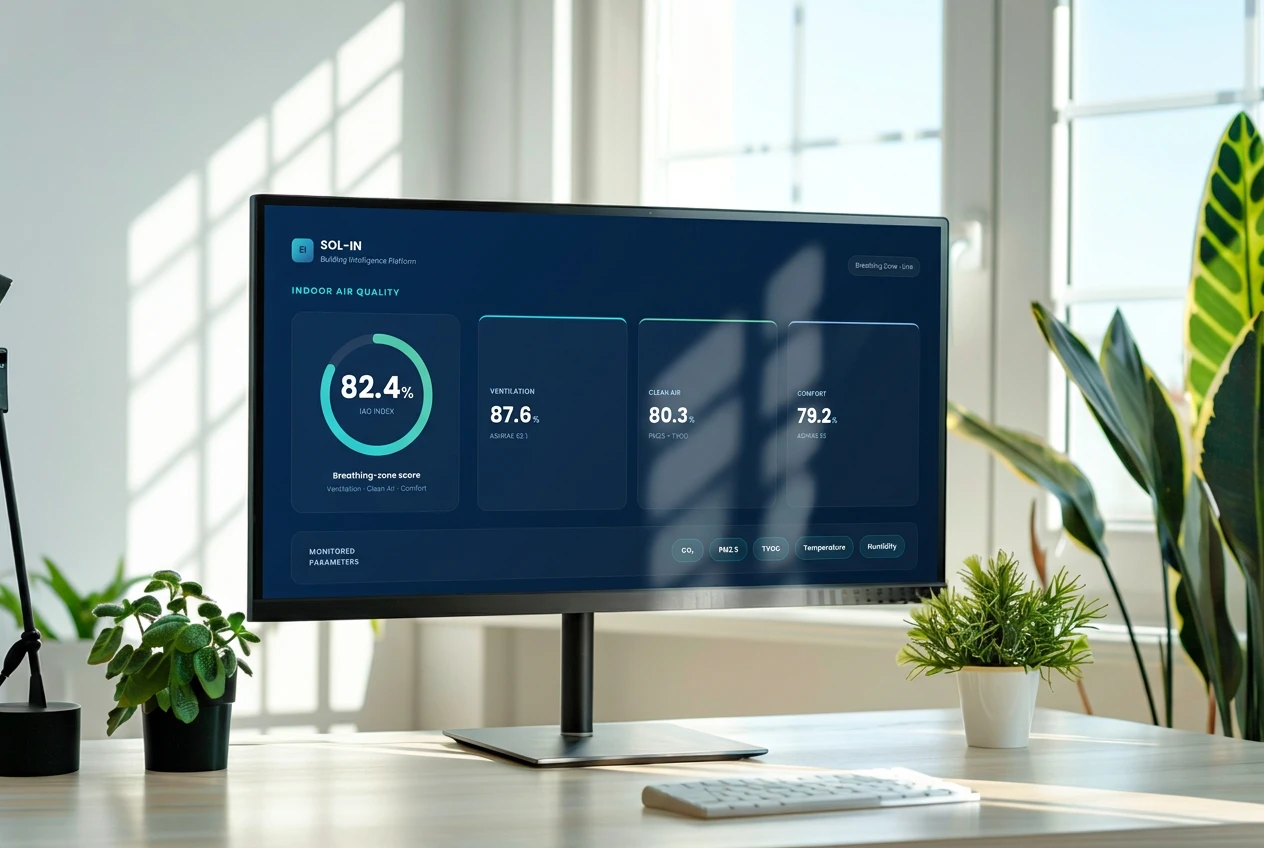
ECO·IN measures air quality where occupants actually experience it – in the breathing zone – and uses occupancy-related demand, IAQ, and thermal signals to guide HVAC response. The result is better visibility, smarter ventilation, improved comfort, and stronger indoor-environment evidence.
- Breathing-zone sensing
- Occupancy-related demand
- HVAC response, not just monitoring
Field-proven in active buildings
ECO·IN Building Intelligence Platform has already been validated in complex, occupied environments – from healthcare and institutional campuses to protected-living facilities and commercial buildings.
Choose the outcome you want to improve first
Whether the priority is reducing HVAC waste, proving climate performance, improving indoor conditions, or strengthening operational visibility, ECO·IN turns real building demand into action – and action into measurable evidence.