
ECO·IN Building Demand Intelligence Platform
Sol AI – The “Control” Layer
Anticipate demand. Act with precision.
Sol AI was not trained in the lab or on generic building data. Sol AI is the decision engine, and Sol AirDCV and Sol SmartCoil are the execution layer. Together, they turn the real behavior of your specific building – its CO₂-metabolic occupancy patterns, thermal fingerprints, usage rhythms, and verified operating history – into intelligent HVAC control. No two buildings produce the same model. Instead of reacting to thresholds or issuing binary on/off commands, ECO·IN modulates damper position, fan speed, valve opening, and setpoint through proportional adjustments within calibrated limits.
Not a Relay. Not a Motion Sensor. Not a Smart Office Controller.
ECO·IN does not react like a sensor, switch like a relay, or generalize like a shared AI model.
It learns the building and controls HVAC accordingly.
Other approaches
ECO·IN
Motion / PIR sensor
Detects presence and triggers a binary on/off response.
Reads occupancy-related demand patterns, including CO₂ rise-and-decay signals, to understand how demand is changing and what HVAC response the space needs.
Smart relay / BMS schedule override
Turns equipment on or off based on time, threshold, or simple override logic.
Modulates fan speed, damper position, valve opening, and setpoint proportionally – using all four Signatures together, not a single trigger.
Generic AI / ML platform
Applies a shared model trained across many buildings.
Sol AI learns from the specific building – its occupancy patterns, thermal fingerprints, usage rhythms, and decision history.
Gives every building its own model, built from its own 17+ parameter signal stream.
What the Sol AI Layer Does
Sol AI turns building understanding into real-time decisions. It reads the Building Signatures created over time, anticipates demand, activates HVAC control where appropriate, and provides recommendations where systems should remain read-only. This is the layer that moves the platform from understanding to action.
01
Anticipate real demand
Detect how spaces, systems, and usage patterns are changing in real time, so the building can respond to actual demand instead of fixed schedules.

02
Control HVAC where appropriate
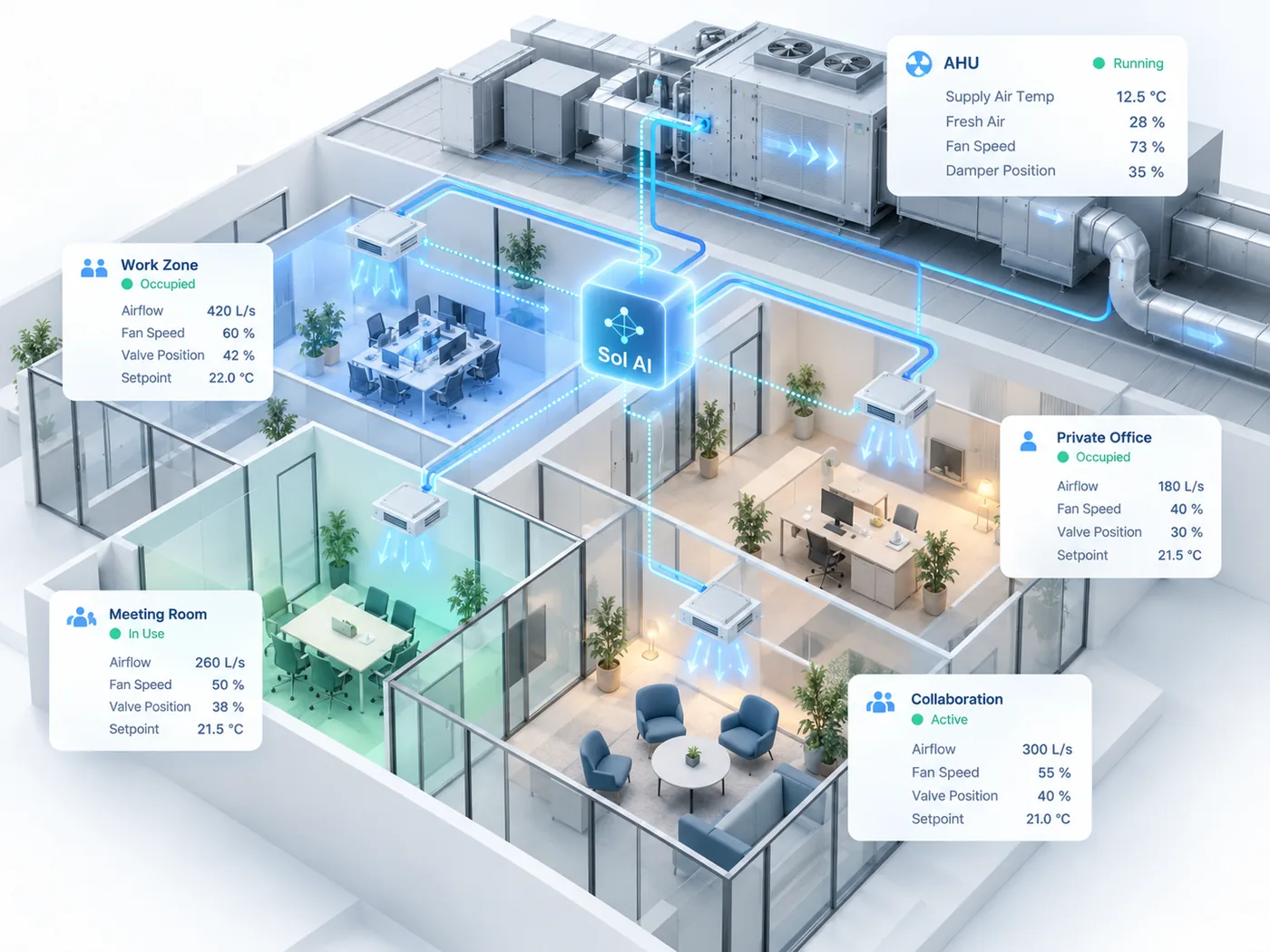
Sol AI is the decision engine, and Sol AirDCV and Sol SmartCoil are the execution layer. Together, they turn real demand into precise HVAC action – across airflow, fresh air, fan speed, valve position, and setpoint – instead of relying on fixed schedules.
03
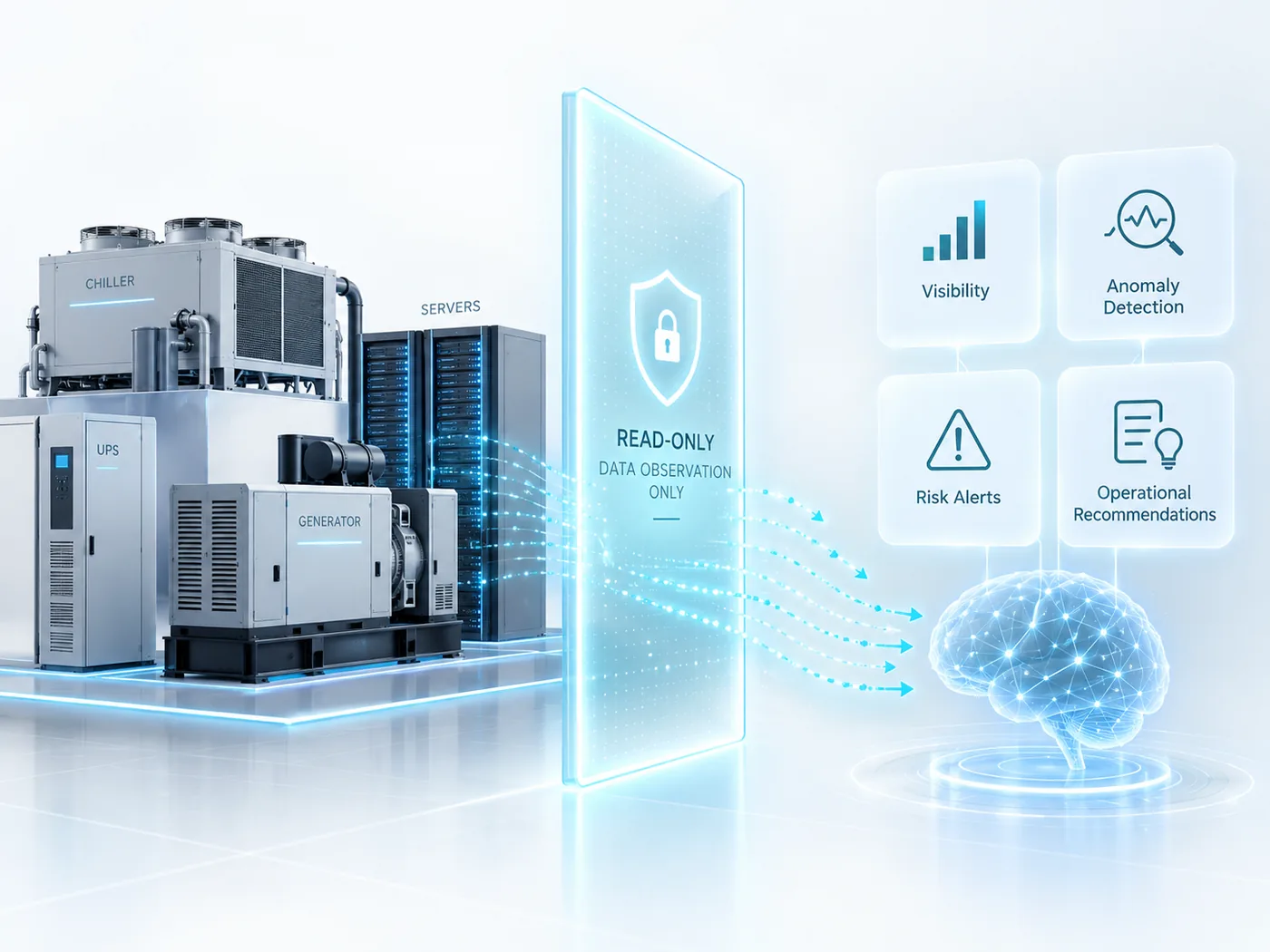
Recommendations for read-only systems
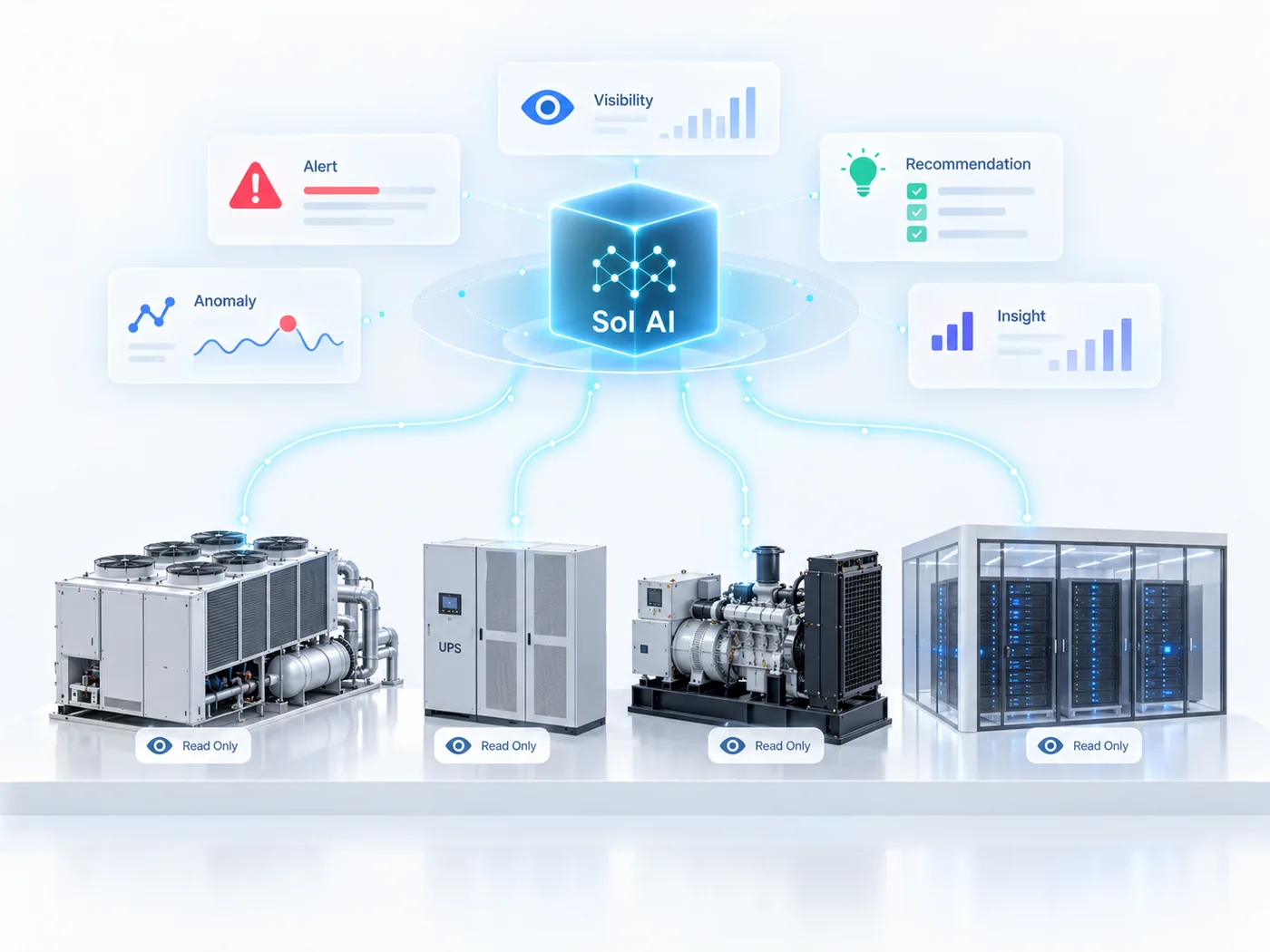
Provide visibility, alerts, and recommendations for systems that should remain read-only, such as chillers, UPS, generators, server rooms, and other critical assets.
ECO·IN’s Sol AI is not generic AI applied to buildings. It is built on continuous monitoring, pattern analysis, and correlations across occupancy, IAQ, thermal behavior, and energy use. Each deployment begins by learning the building – not from a generic model, but from the metabolic patterns, thermal fingerprints, and occupancy rhythms unique to its operation. The result is building-specific AI that understands the building the way an experienced operator does – except it never forgets, never goes off shift, and continuously refines its model over time.
Core Sol AI Capabilities
Sol AI – The Decision Intelligence Engine
Sol AI is the decision-making core of the ECO·IN Building Demand Intelligence Platform. It reads the four Building Signatures in real time, matches current conditions against the building’s own calibrated patterns, and issues bounded HVAC decisions through two execution points: Sol AirDCV for ventilation and AHU response, and Sol SmartCoil for zone-level temperature, fan speed, and valve control. Sol AI does not operate on generic logic. It runs on the specific operational model this building has built from its own data – and it improves that model every time a decision is made and its outcome is measured.
Predictive Demand Engine
Traditional systems react. ECO·IN anticipates.
ECO·IN does not work from a single time horizon. It maintains five simultaneous forecasts, each informing a different level of the system:
5 minutes
Zone-level signals: CO₂ rise rate, temperature delta, occupancy pattern. Drives immediate FCU and AHU modulation through Sol AirDCV and Sol SmartCoil.
15 minutes
Thermal response window. If a zone will need conditioning before the system can respond in time, action begins now – not when the threshold is crossed.
60 minutes
Chiller and pump context. Informs whether additional capacity is required, whether a second chiller should be staged, and whether pump VFD can be reduced safely.
End of Day
Schedule vs. actual usage reconciliation. Identifies early shutdown opportunities and avoids post-occupancy waste.
Tomorrow morning
Pre-conditioning logic based on historical occupancy patterns, outdoor temperature forecast, and thermal signature for this zone on this day type.
This is the difference between a system that reacts to what has already happened and one that prepares for what is about to happen.
Precise Control Within Defined Limits
Control where direct action is appropriate
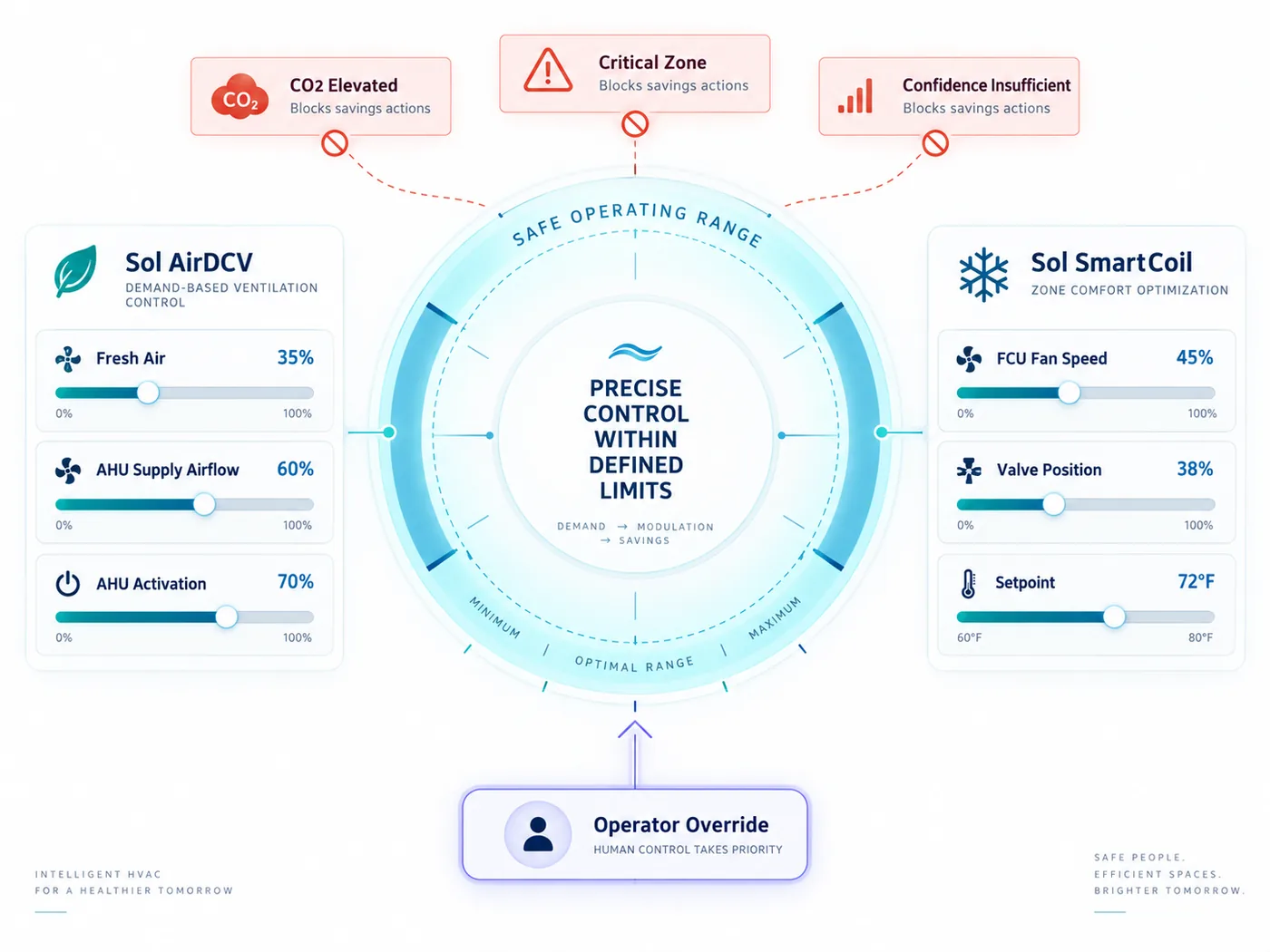
Sol AI turns demand signals into precise HVAC modulation through Sol AirDCV and Sol SmartCoil. Sol AirDCV adjusts fresh-air volume, AHU supply airflow, and AHU activation based on real demand and cross-signature confidence. Sol SmartCoil modulates FCU fan speed proportionally, repositions the chilled water valve based on actual thermal load, and adjusts setpoints within comfort-safe limits. This is controlled HVAC action – proportional, bounded, and building-specific. One constraint applies across all control actions: no savings are taken when CO₂ is elevated, when a zone is in Critical state, or when confidence is insufficient. Operator override is always available and always takes precedence.
From Zone Intelligence to Plant Signal
Turn local demand into plant-level guidance
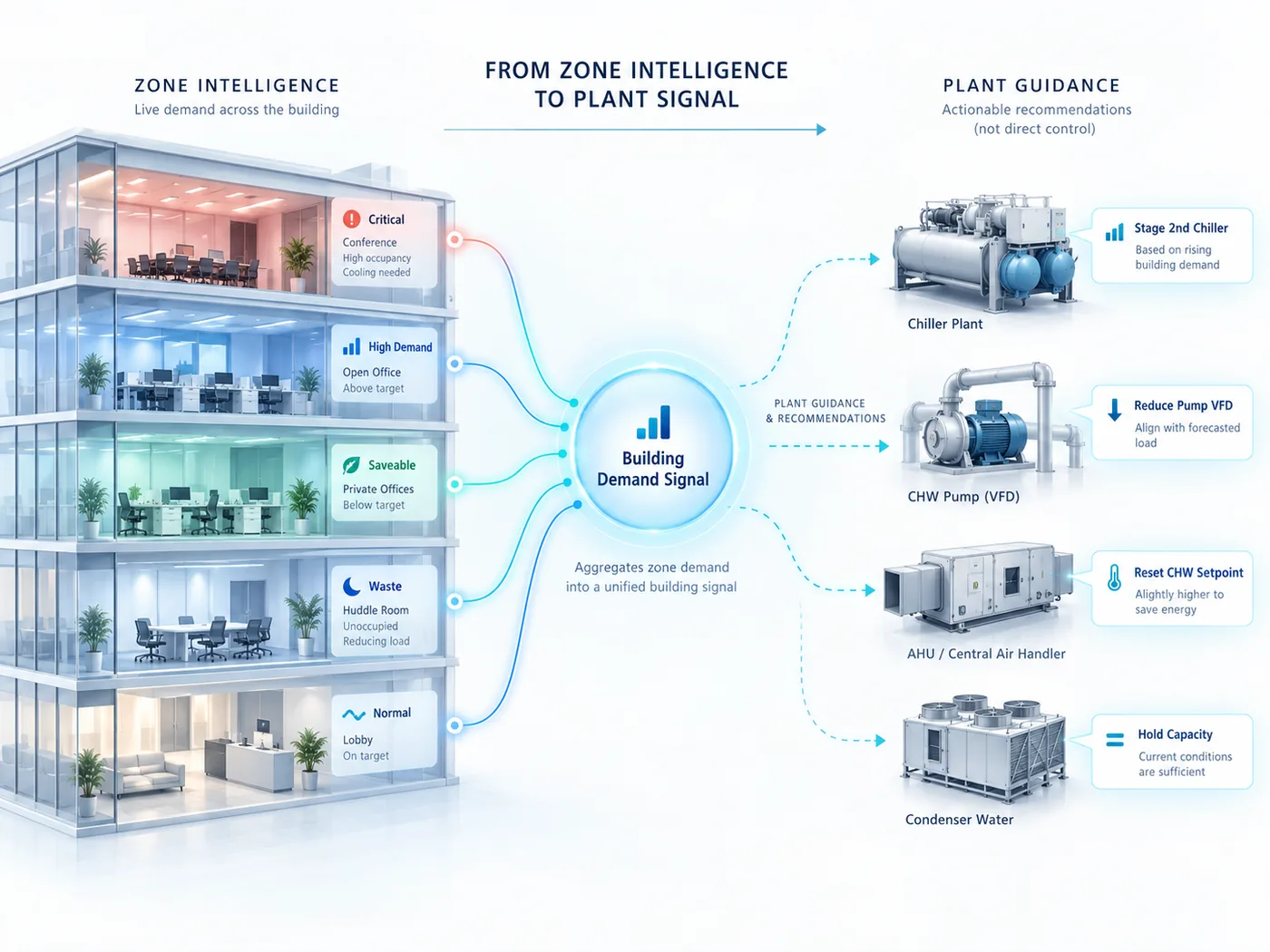
Local control at zone level is only part of what Sol AI does. Every five minutes, it turns the live state of the building – from Critical and High-demand zones to Saveable and Waste zones – into a Building Demand Signal that shows where demand is real, where capacity is unnecessary, and where waste is accumulating. That signal drives plant-level recommendations such as staging a second chiller, resetting chilled-water setpoint, reducing pump VFD speed, or holding capacity when demand does not justify more. ECO·IN does not command the plant. It gives the plant the demand context it has never had.
Building Signatures & Demand Logic
Go beyond simple detection
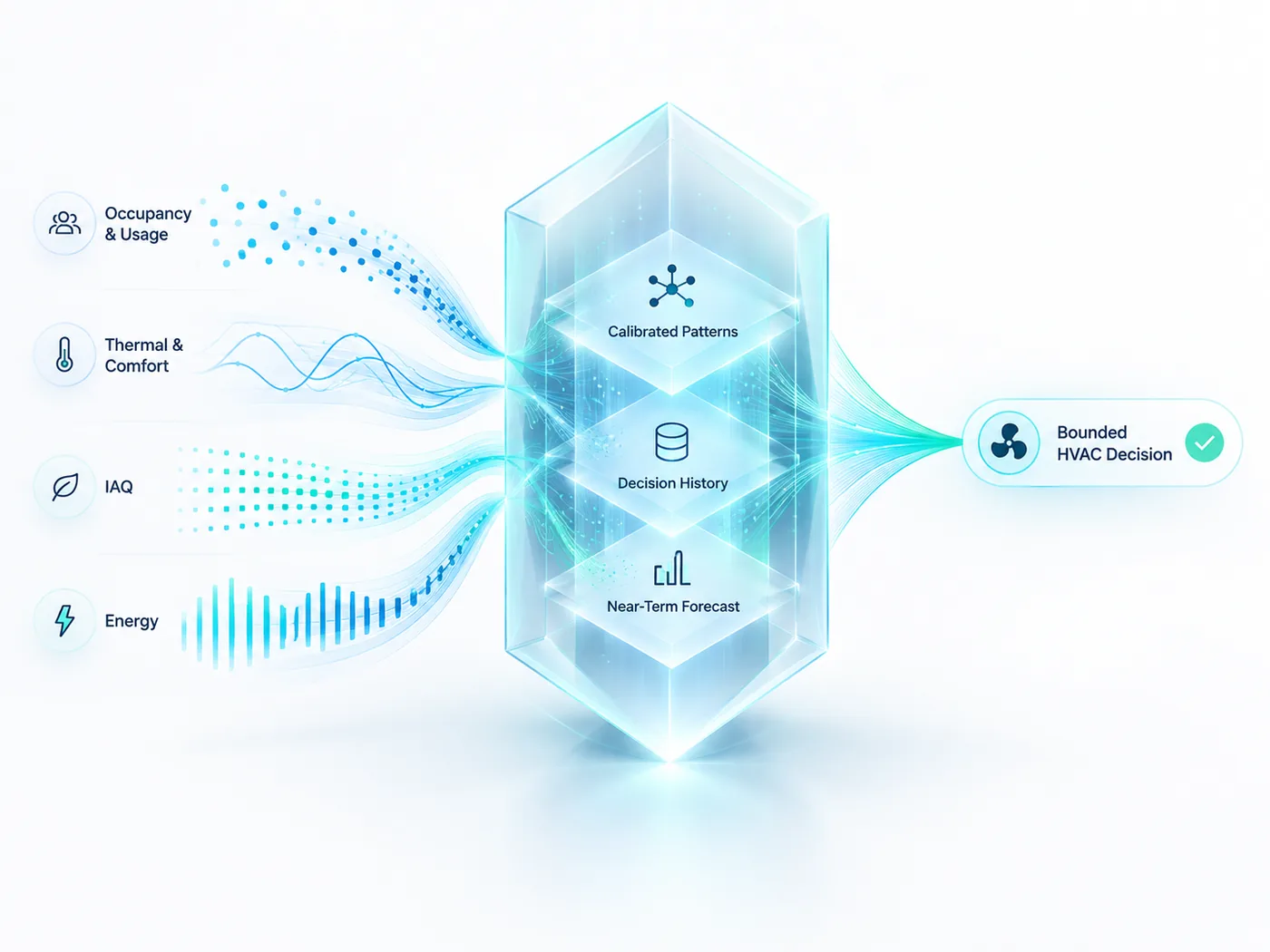
The Sol AI layer does not jump from a signal to a command. It reads the live state of each Signature against the building’s calibrated patterns, checks how similar situations were handled before, looks at where demand is heading next, and only then issues a bounded HVAC decision. That is how ECO·IN turns building-specific intelligence into controlled action instead of reacting to isolated events.
Recommendations for Read-Only Systems
Intelligence without unnecessary control risk
For systems that should not be directly controlled, the Sol AI layer provides visibility, anomaly detection, risk alerts, and operational recommendations. This allows ECO·IN to explain performance gaps and identify waste without adding unnecessary control risk.
Every Decision Is Logged. Every Outcome Is Measured.
ECO·IN does not operate as a black box. Every control action is recorded in the Decision Log: the state of all four Signatures at the moment of decision, the reason code that triggered the action, the action taken, the measured outcome, and the resulting model update.
This is what makes the system improve over time – and what makes VEM’s evidence defensible. Every saving VEM reports is anchored to a logged decision. Every logged decision is anchored to a demand signal.
Signature state
Reason code
Action taken
Measured outcome
Model update
ECO·IN Earns the Right to Act. It Does Not Assume It.
Before ECO·IN takes any control action in a building, it must earn the confidence to do so – through its own track record, not through a default setting.
The system moves through defined stages.
Monitoring & Detection
Data is collected and baselines are established. No control actions are taken.
Recommendations
Sol AI identifies waste, anomalies, and demand patterns. Recommendations are surfaced to operations teams for review.
Supervised Action
Control actions are executed with operator approval. Outcomes are logged and measured.
Autonomous – Limited
Actions within verified, safe parameters execute automatically. Override is always available.
Full Closed Loop
Building-specific AI operates continuously, with complete Decision Log visibility and VEM verification at every step.
Confidence is calculated from four inputs: data quality, pattern stability, historical accuracy of predictions, and measured outcomes from prior actions. Every successful decision raises it. Every override or anomaly is factored in. The system does not assume it has earned a level of trust – it demonstrates it, building by building, decision by decision.

Every Decision Becomes Verifiable Evidence
ECO·IN closes the loop between demand, action, and verification.
Signatures
Governance Check
AI Decision
AirDCV / SmartCoil
Decision Log
VEM
Every saving is traceable to a decision. Every decision is traceable to a demand signal.
Operational Impact
Turn demand into action
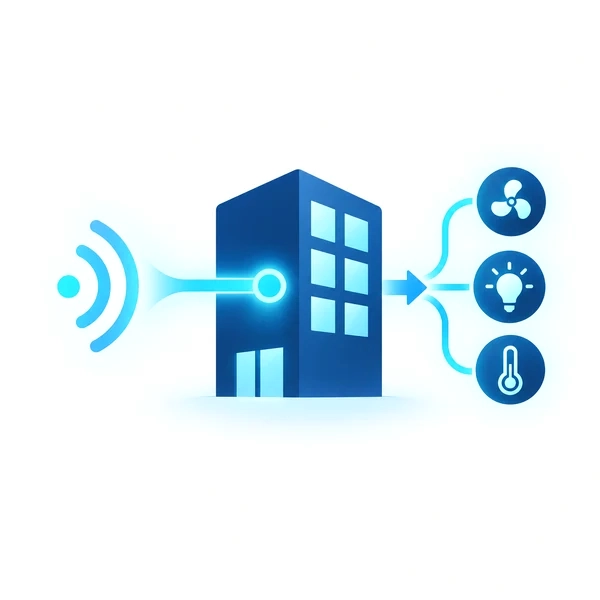
Move beyond schedules, habits, and fragmented control logic with intelligence that responds to how the building is actually operating.
Anticipate instead of react
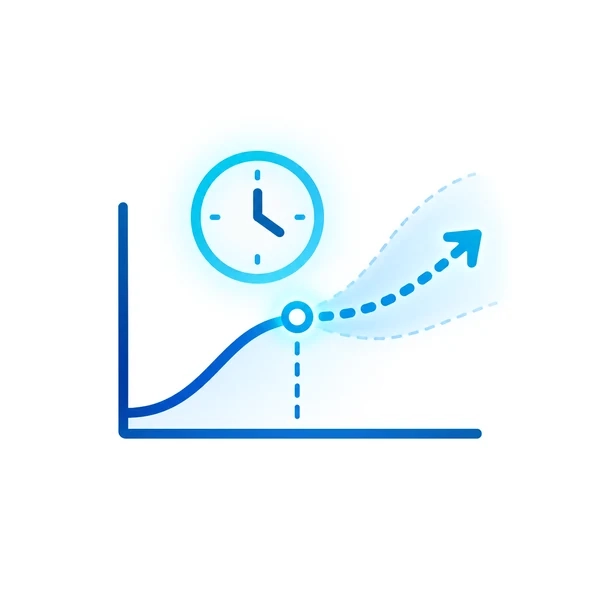
Traditional systems wait for thresholds after waste has already happened. ECO·IN uses predictive operational intelligence to respond earlier and more precisely.
Stronger path to verified savings
Turn operational understanding into decisions and actions that can later be proven in energy, cost, and carbon terms through VEM.
The Sol AI control layer supports both Energy Savings & ROI and Climate, ESG & MRV by turning real demand into action. Every decision is tagged with a reason code and expected outcome, and VEM turns that tagged delta into performance evidence.
One platform. Four layers. Measurable performance.
Cut through blind spots, fixed schedules, and unverified claims with one connected system built to measure, understand, control, and verify.