
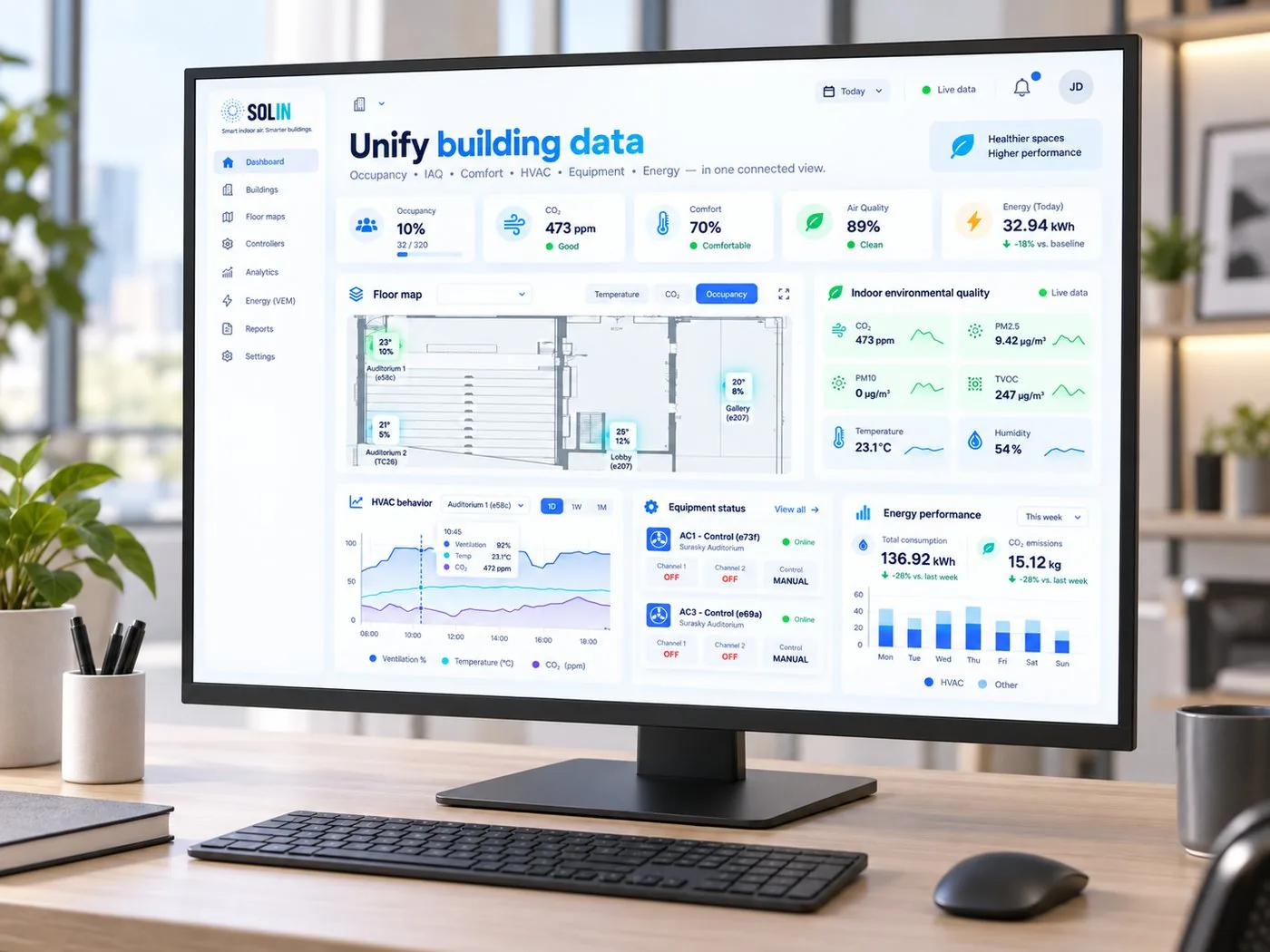
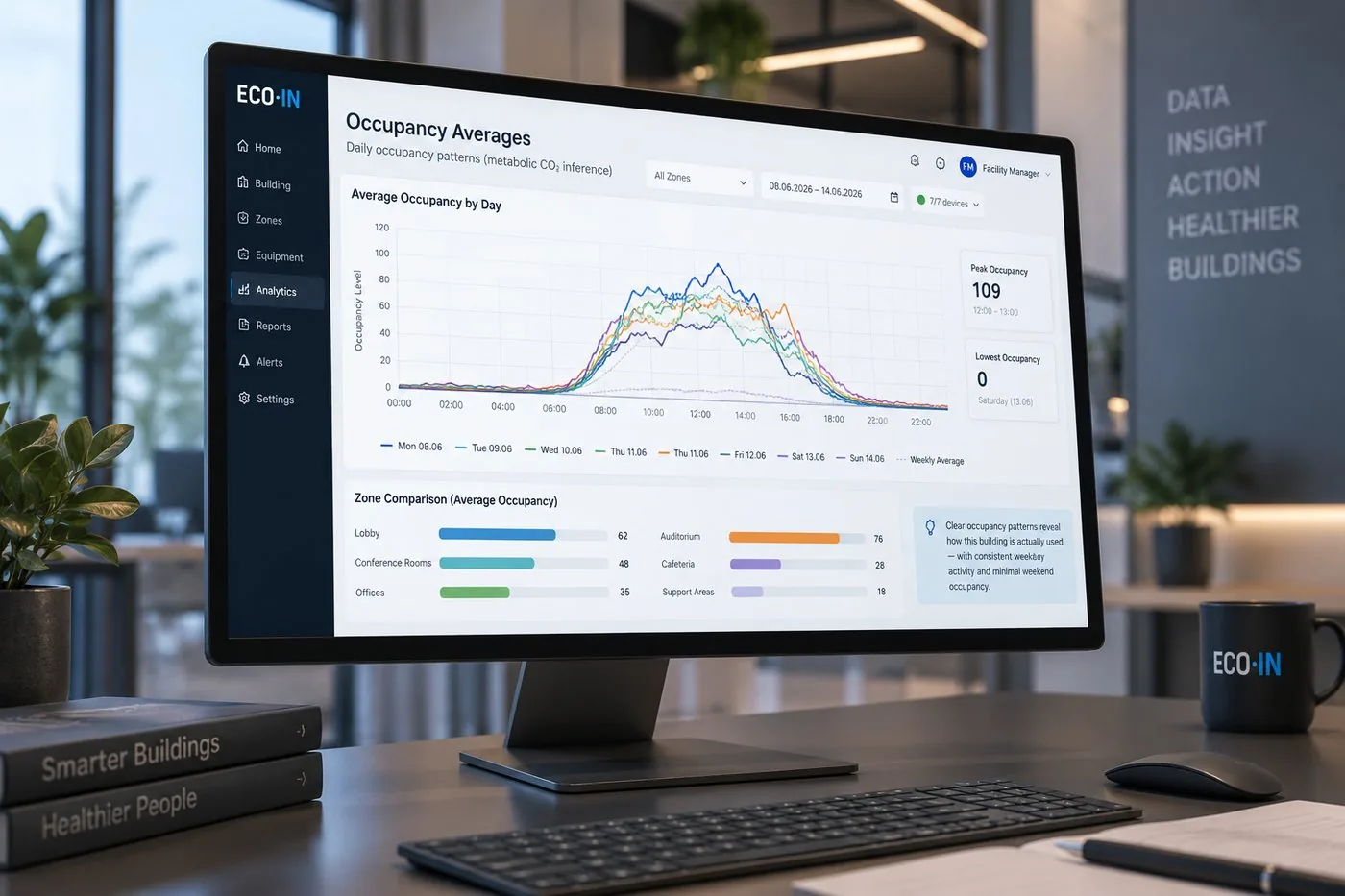
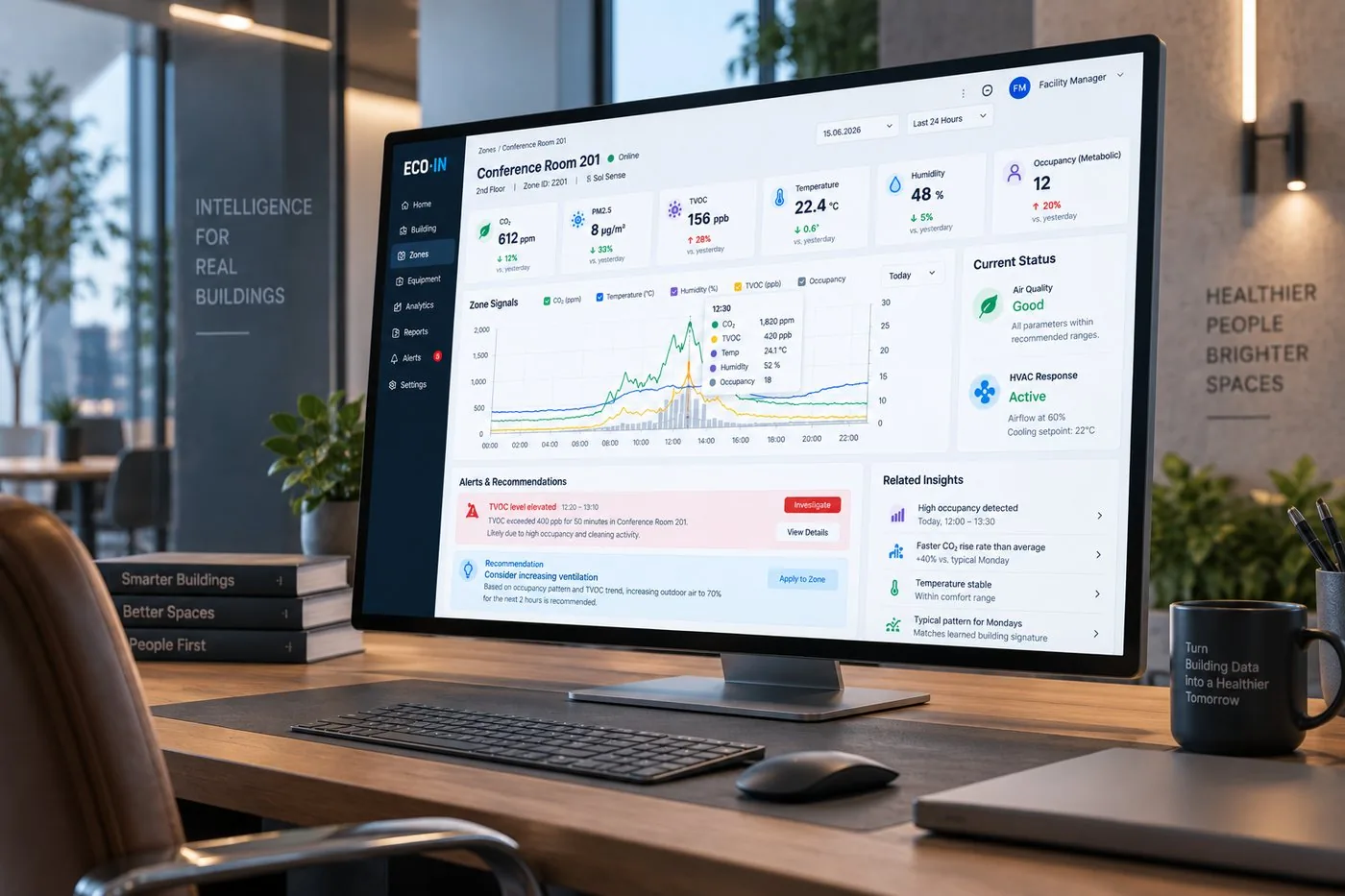
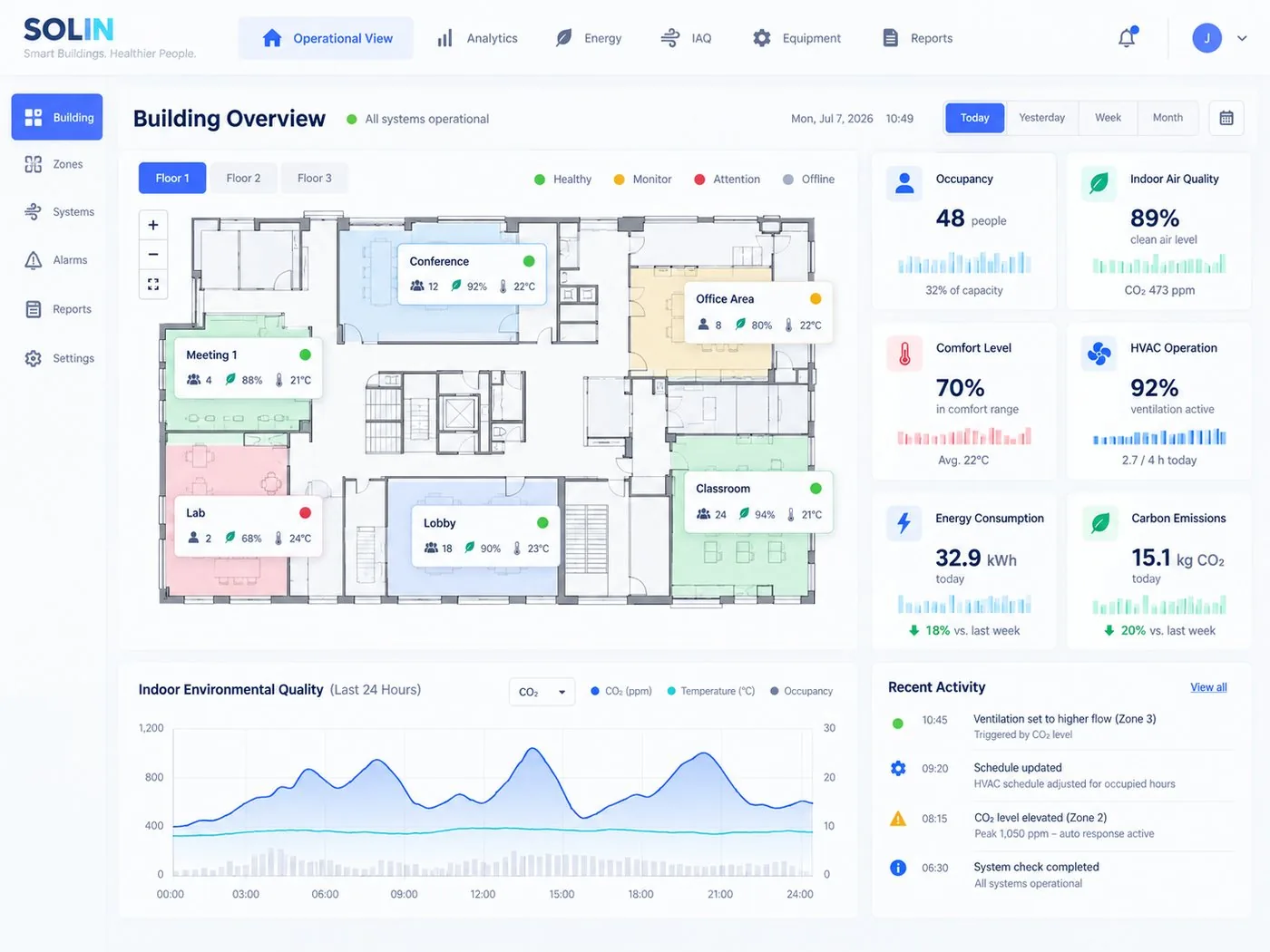
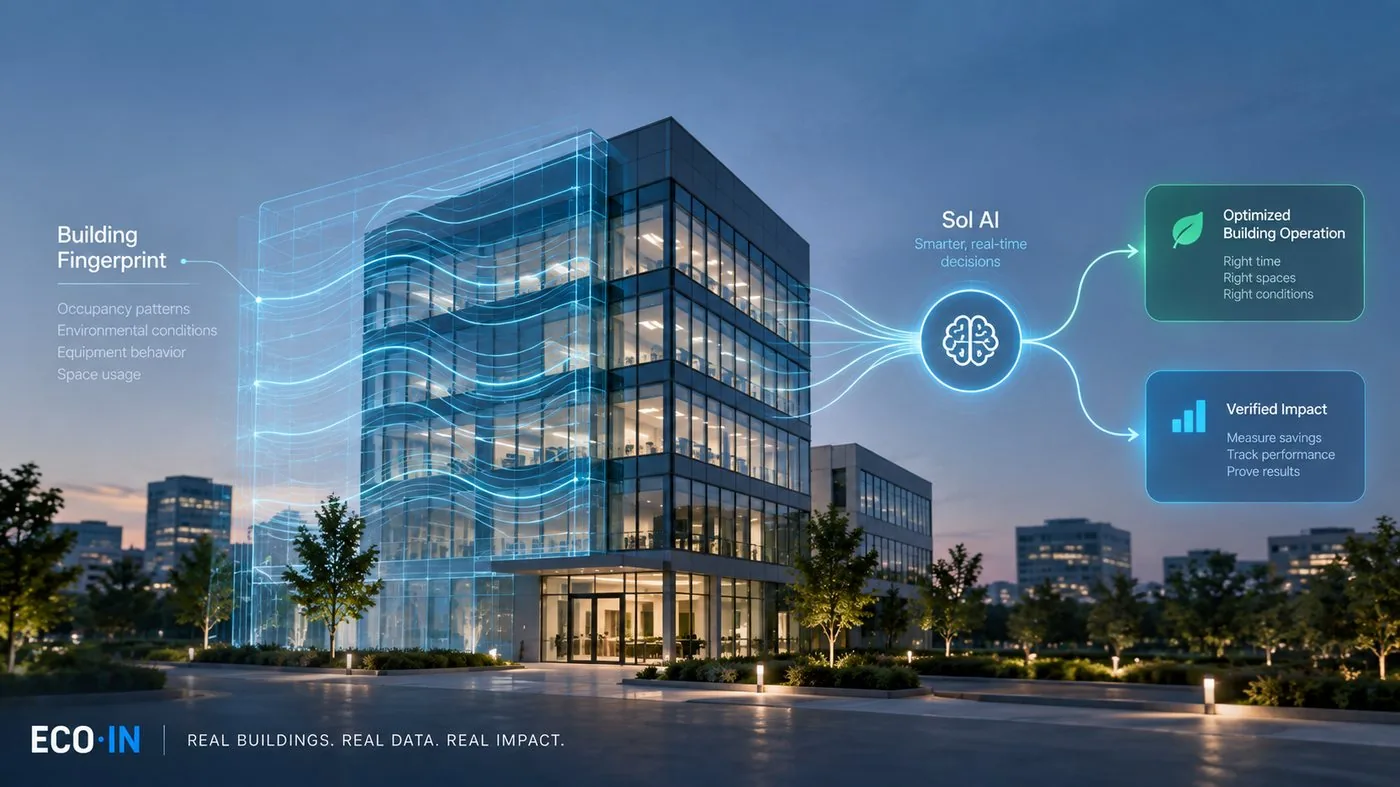



The ECO·IN software layer does not rely on a generic model. It learns each site from its own data – 17+ parameters captured every 10 seconds, calibrated over weeks of real operation, and refined continuously over time. The result is building-specific intelligence shaped by this site’s occupancy-related demand patterns, zones, HVAC configuration, and this building’s own operating patterns. Other platforms show what is happening. ECO·IN learns how the building actually behaves.
The BMS sees what is running.
ECO·IN knows if it should be running.
BMS dashboards
Show status and operate according to configured logic.
Understands demand, learns patterns, and supports verified savings through VEM.
Monitoring platforms
Show dashboards, alerts, and trends.
Adds a building-specific intelligence layer that learns this site and drives HVAC decisions.
Alerts + manual recommendations
Flags waste against generic benchmarks, but still depends on people to interpret and act.
Calibrates to this building, manages local HVAC directly, and verifies the result through VEM. Recommendations are reserved for plant-level systems.
Generic AI platforms
Use a model built in the lab and deployed the same way across buildings – regardless of how differently those buildings actually behave.
Gives every building its own model, built from its own 17+ parameter signal stream.
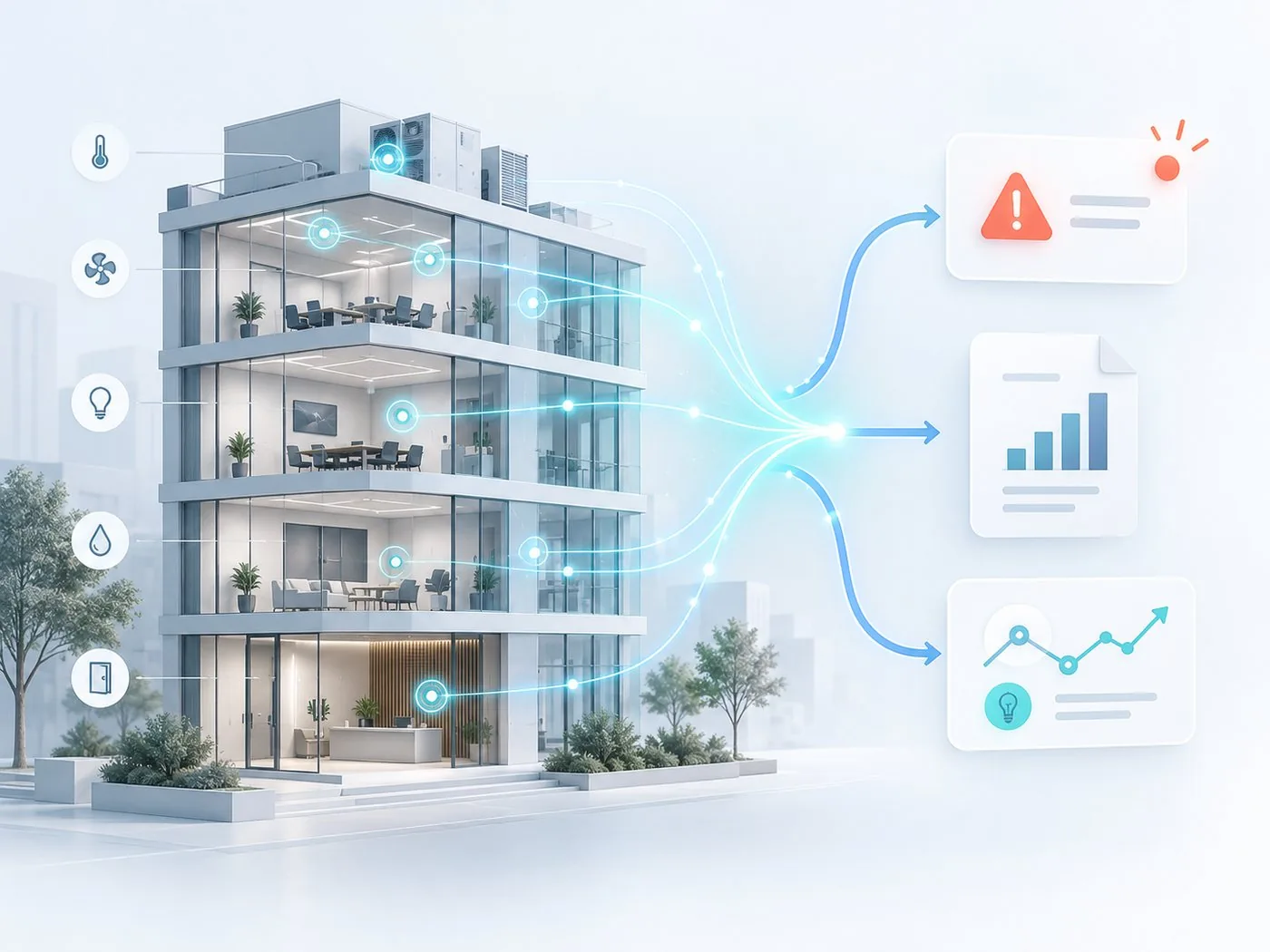
The ECO·IN software organizes building signals and baselines into one operational view, builds the signatures that describe how the building actually behaves, and turns raw data into patterns, anomalies, and context the rest of the platform can act on. This is the layer that turns real demand into operational understanding.
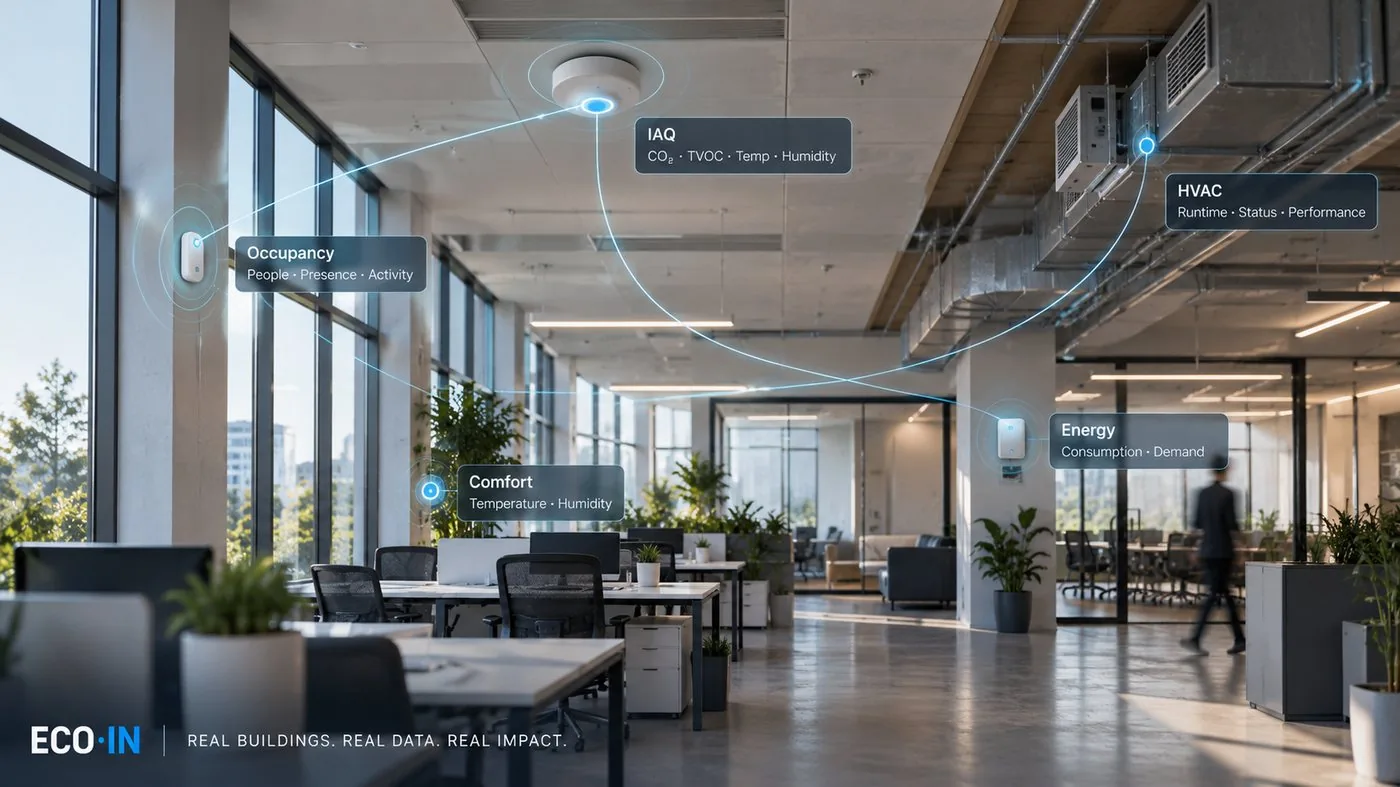
Bring together occupancy, IAQ, comfort, HVAC behavior, equipment status, and energy data into one connected operational view.
Turn room, zone, and system-level signals into the patterns that show how the building is actually used, how it responds, and where real demand appears over time.
Convert room-level and system-level data into dashboards, alerts, trends, and recommendations that operations teams can actually use.
A live view of how the building actually behaves
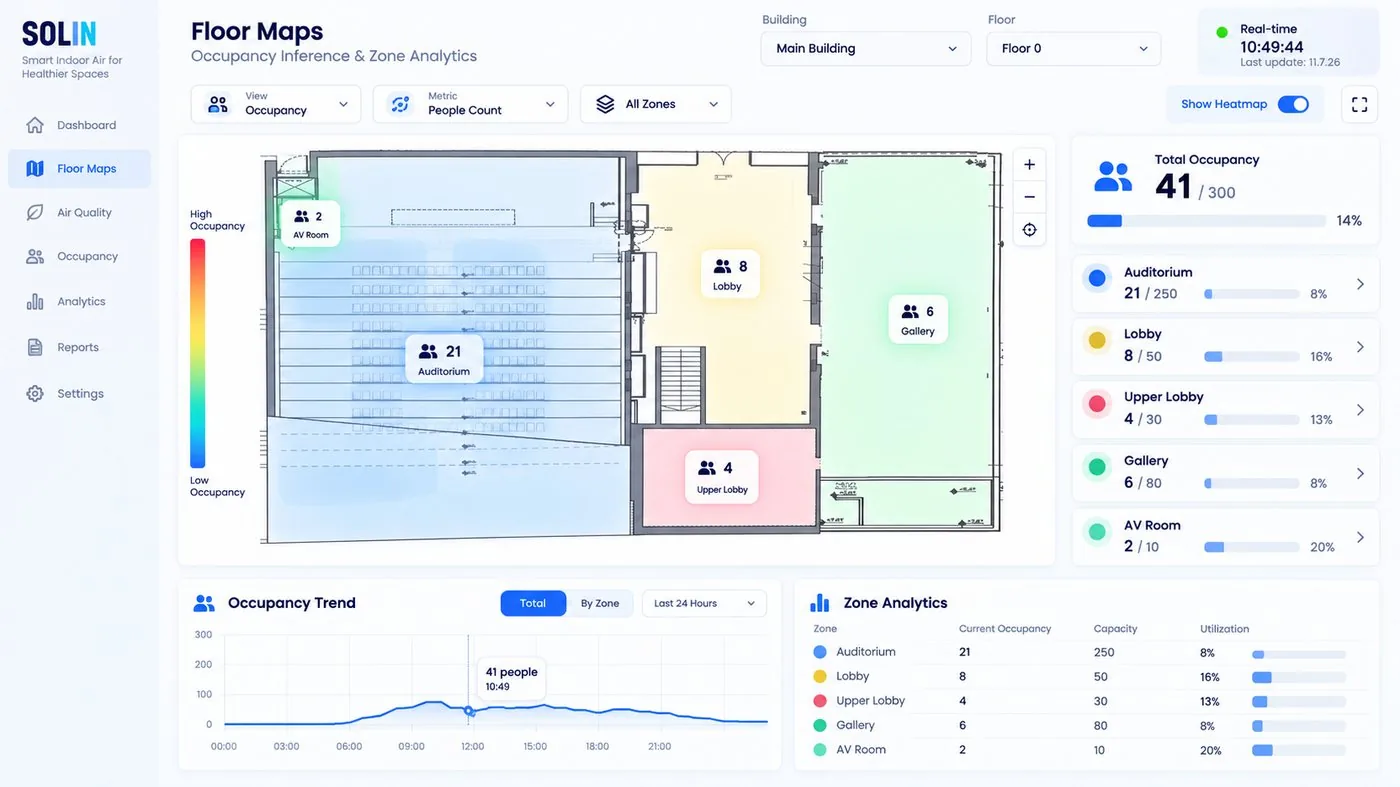
The ECO·IN interface does not display raw sensor data. It displays the building’s behavioral model – the calibrated Signatures, the anomalies detected against the learned baseline, and the Decision Log showing what Sol AI decided, why, and what happened next. A facilities manager opening the platform is not looking at data feeds. They are looking at a live model of how the building actually behaves.
No two buildings learn the same way
No two buildings produce the same Building Signatures. Take two similar buildings – same architect, same HVAC brand, same occupancy type, even the same floor plan – and within weeks of calibration, their Signatures will still diverge. Different occupancy rhythms, different thermal response curves, different IAQ profiles, different energy behavior. The model belongs to this building and cannot be imported, copied, or transferred to any other site.
Go beyond basic detection
ECO·IN does not rely on PIR or motion events to guess demand. That old logic turns on an open space because one person moved, then shuts systems down when people stop moving. ECO·IN reads the CO₂-metabolic signature – how human presence actually appears in the air relative to the calibrated baseline for this zone at this time of day. A cleaning team creates a different signature than a meeting group. A single person sitting quietly creates a different signal than a space that has just emptied. The software distinguishes between them, and Sol AI responds accordingly.
Surface what teams need to know
The software identifies waste, anomalies, and operational gaps against the learned baseline – from early cooling and late shutdown to equipment behavior that no longer matches building use. It also records the Decision Log that helps the platform become more accurate over time, showing what Sol AI decided, why, and what outcome followed.
Before ECO·IN makes a single control decision, the Software layer documents the building’s baseline across the core dimensions of building behavior. This is where the platform reveals how the building actually operates before optimization begins – often exposing patterns teams did not know were there.
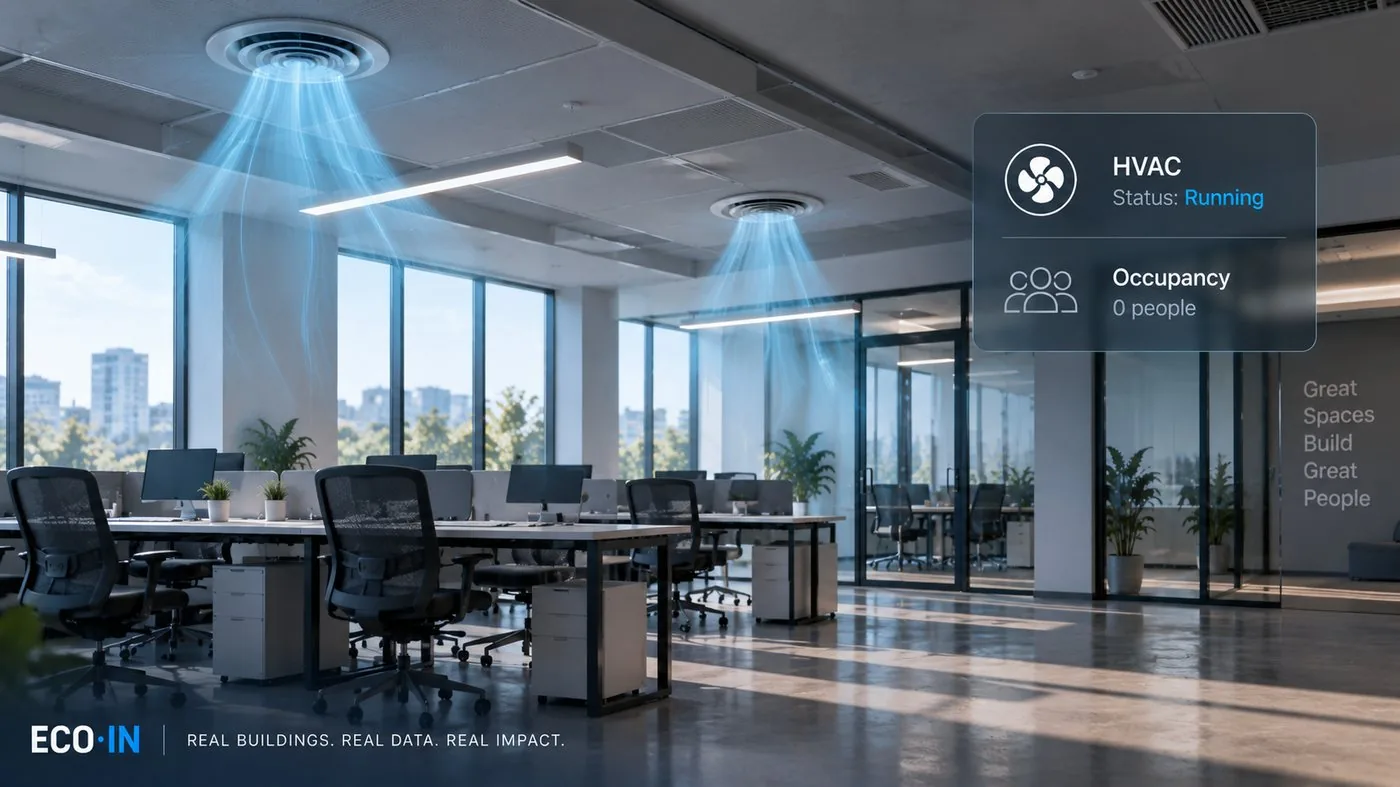
In many buildings, that first picture is surprising: HVAC systems running for hours after occupancy ends, pre-cooling starting long before anyone arrives, or equipment consuming far more energy than demand conditions justify. What looks normal in a BMS or dashboard often turns out to be expensive, avoidable waste once the baseline is documented clearly.
That baseline becomes the reference point for every decision that follows. It is the foundation for VEM savings calculations, the context behind later Sol AI control decisions, and the first deliverable ECO·IN provides: the building’s actual operating reality, documented before optimization begins.
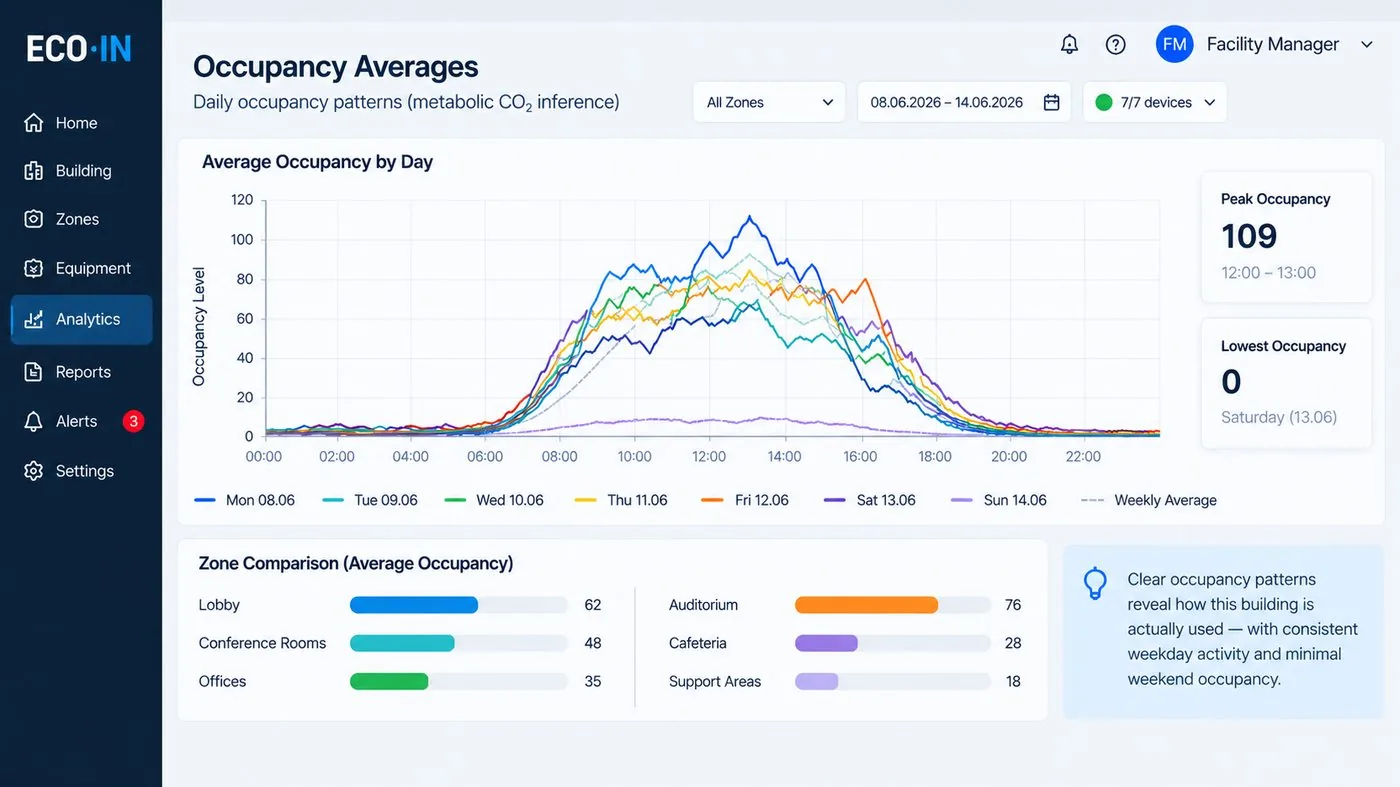
Shows how occupancy-related demand changes over time – when spaces become active, quiet, peak, or follow event-based patterns instead of fixed schedules. This is how ECO·IN distinguishes real HVAC demand from assumptions based on calendars or static operating logic.
Shows how CO₂, PM2.5, TVOC, humidity, temperature, and ventilation behavior change by room, time, use, and occupancy conditions. This is how ECO·IN distinguishes between real fresh-air demand, pollution events, crowding, cleaning activity, or ventilation problems.
Shows how each zone responds to temperature, humidity, heat or cooling load, occupancy, and HVAC operation over time. This is how ECO·IN understands whether cooling or heating is truly needed, how quickly comfort is reached, and whether system operation is actually affecting the space.
Shows not just how much HVAC energy was consumed, but when, where, by which component, under what demand condition, and whether that energy was actually required. This is the signature that connects operational action to financial and energy proof.
Sol AI does not react to a single number. It reads a pattern the building has already taught it.
What is happening right now – CO₂ level, room temperature, AHU status, and other live signals captured every 10 seconds.
What this building normally does at this time, on this day type, at this occupancy level – built from weeks of observed behavior.
What Sol AI decided the last time this pattern appeared, and what outcome followed.
Where demand is heading next – 5, 15, 60 minutes ahead, and later in the day or week – based on current conditions and patterns.
Zone-level intelligence is only the beginning. ECO·IN combines what it learns across rooms, zones, floors, and systems into a live Building Demand Signal – showing where demand is rising, where it is absent, and where waste is already forming.
That signal supports smarter plant-level operation: staging cooling only when needed, resetting water temperature more intelligently, reducing pump speed when possible, and avoiding unnecessary capacity. ECO·IN does not replace the plant controller. It gives the plant the demand context it has never had.
Not a generic benchmark, not an imported average, and not a model shared with any other site. ECO·IN builds an operational model shaped by this building’s own occupancy behavior, thermal response, IAQ profile, and energy patterns.
Reveal what the building is actually doing before a single control action is taken – including the waste, timing gaps, and operating problems no one knew were there.
(1) Real-time signals, (2) calibrated patterns, (3) decision history, and (4) predictive forecasting come together to give Sol AI the context it needs for building-specific decisions and defensible VEM outputs.
Cut through blind spots, fixed schedules, and unverified claims with one connected system built to measure, understand, control, and verify.